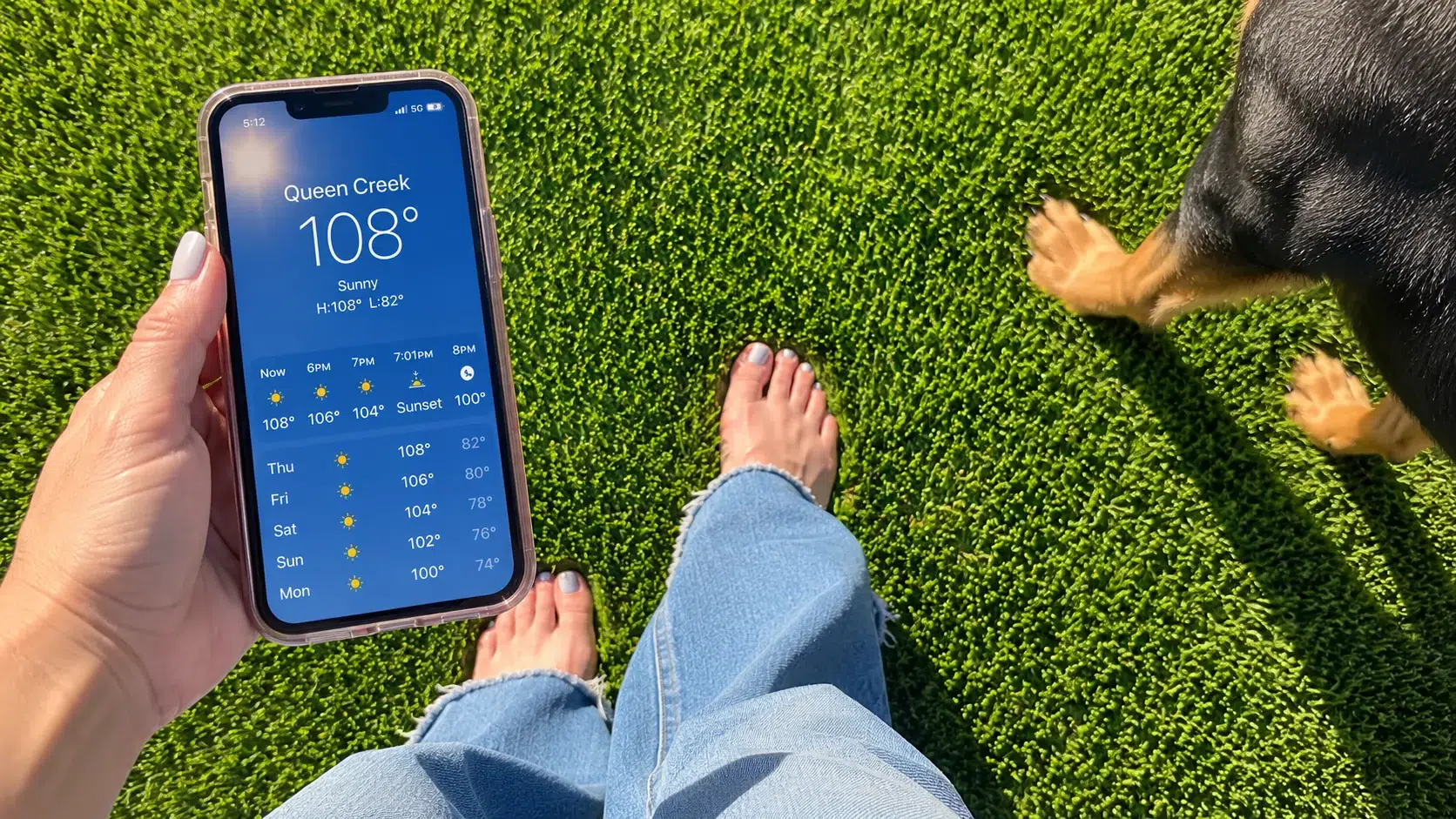
How Hot Does Artificial Turf Get in Arizona and What Can You Do About It?
How Hot Does Artificial Turf Get in Arizona and What Can You Do About It?
If you’re considering artificial turf in Arizona, there’s one question you should ask before choosing a product:
How hot is it going to get?
Let’s answer that right away.
Yes, artificial turf can get hot in Arizona.
So can concrete, pavers, playground equipment, pool decking and just about everything else sitting in direct Phoenix sunlight during the middle of summer.
At No Limit Turf, we’d rather have that conversation with customers upfront than pretend heat isn’t something Arizona homeowners need to think about.
The better questions are: How will you use the space? How much direct sun does it receive? Who will be using it? And what can you do to make the area more comfortable?
Those answers can help you make a much better turf decision.
Why Does Artificial Turf in Arizona Get Hot?
Artificial turf absorbs energy from the sun.
Unlike natural grass, synthetic turf doesn’t contain living plant material and moisture that can contribute to evaporative cooling. That means turf exposed to direct Arizona sunlight can become considerably warmer than the surrounding air.
And this isn’t just something turf companies talk about.
The University of Arizona Cooperative Extension identifies heat retention as a major consideration with artificial lawns and reports that surface temperatures can reach approximately 120°F to 180°F on a hot day, depending on conditions.
That’s a big range, and there’s a reason for it.
There isn’t one universal temperature for every artificial turf installation.
The temperature of a particular surface can be affected by things like:
- Direct sunlight
- Time of day
- Time of year
- Shade
- Turf construction
- Infill
- Air movement
- Surrounding hardscape
- Reflected sunlight
- Moisture on the surface
That’s why we’d be cautious about anyone giving you one temperature and saying that’s exactly how hot your future yard will get.
Every property is different.
Start With How You’re Going to Use the Turf
This is one of the most important conversations we have when helping someone choose artificial turf in Arizona.
What are you actually building?
Is it a front yard that’s primarily there for curb appeal?
A backyard entertainment area?
A dog run?
A play area for kids?
A putting green?
A commercial property?
Those aren’t the same application.
Surface temperature matters much more when you’re talking about bare feet and paws than when you’re talking about decorative landscaping that people rarely walk across.
That’s why we encourage customers to compare turf based on how the finished space will actually be used, not just which sample looks the best.
No Limit Turf carries artificial turf for Residential Artificial Turf , pet areas, playgrounds, sports, putting greens, rooftops and other applications, so there isn’t one product we’re going to recommend for every project.
Shade Can Make a Big Difference
If you’re planning a backyard, don’t think about the turf by itself.
Think about the entire outdoor space.
Where does the house cast shade?
Do you have mature trees?
A covered patio?
Pergola?
Umbrellas?
Shade sails?
If kids or pets will regularly use the turf, creating shaded areas can make the overall space much more practical during Arizona summers.
You don’t necessarily need to shade every square foot of the yard.
Think about where people and animals will actually spend their time.
Can You Cool Artificial Turf With Water?
Yes.
A quick rinse with water can temporarily lower the surface temperature.
That’s useful if you’re about to use the yard, especially around a patio, play area or pet space.
Just understand that it’s temporary.
Once the water evaporates and the turf remains exposed to direct sunlight, the surface can begin warming again.
That’s one reason we view rinsing as a useful tool rather than a permanent solution to Arizona heat.
What About Artificial Turf and Dogs?
This deserves its own conversation.
Dogs aren’t wearing shoes.
During extreme summer heat, check the temperature of outdoor surfaces before allowing your dog to spend significant time on them.
And that doesn’t apply only to artificial turf.
Check concrete.
Check pavers.
Check pool decking.
If you’re designing a dedicated dog area, think about the layout before the turf goes down.
A completely exposed dog run on the west side of a house can have very different conditions than a partially shaded backyard.
If pets are a major part of your project, No Limit Turf has pet-friendly artificial turf options designed specifically for those applications. We also recommend thinking about drainage, odor control, cleaning and heat as one complete system rather than choosing turf based on appearance alone.
A dog relaxing on artificial turf during a sunny Arizona summer day.
Normal Turf Heat and Turf Burn Are Two Different Things
This is an important distinction.
Artificial turf getting hot from direct Arizona sunlight isn’t the same thing as artificial turf melting from concentrated heat.
We’ve seen enough questions around this subject that we think Arizona homeowners should understand the difference.
Certain energy-efficient windows can reflect concentrated sunlight onto a relatively small area. Depending on the conditions, that reflected heat can become intense enough to curl, shrink or melt synthetic turf fibers.
Windows aren’t the only potential source.
Clear pool floats and inner tubes, certain reflective surfaces, glass features, grills, fire pits and hot landscaping equipment are all things worth considering around synthetic turf.
We’ve put together a separate guide on Artificial Turf Burn in Arizona: What Causes Turf to Melt & How to Prevent It that goes much deeper into window reflection, Low-E glass, pool toys, hot equipment and ways to reduce the risk.
The simple takeaway is:
Hot turf doesn’t necessarily mean damaged turf. Concentrated extreme heat is a different issue.
Be Careful With “Cool Turf” Claims
There are turf products, infills and systems marketed around heat management.
Some may absolutely be worth considering for a particular application.
But we’d be careful about treating any single product feature as though it makes Arizona summer heat disappear.
When choosing artificial turf in Arizona, look at the entire environment:
- What direction does the yard face?
- How much direct sun does it receive?
- Is there shade?
- Are kids or pets using it?
- Is there a pool?
- What surfaces surround the turf?
- Are there windows reflecting onto it?
- How will the area actually be used?
The turf itself is only one part of that equation.
Does Turf Make Sense in Arizona Despite the Heat?
For many homeowners, absolutely.
There’s a reason artificial turf is so common throughout the Valley.
You get a green landscape without mowing a natural lawn and without continually watering grass to keep it alive in our desert climate.
But that doesn’t mean every square foot of every Arizona property should automatically become artificial turf.
Good landscape design is about using the right materials in the right places.
Sometimes that’s turf.
Sometimes it’s pavers.
Sometimes it’s rock, plants, shade structures or a combination of several materials.
We’d rather help someone build a space that makes sense than pretend one product solves every landscaping problem.
Choosing the Right Artificial Turf in Arizona
When someone visits No Limit Turf, we’d rather start by asking questions than immediately point them toward a roll.
Tell us:
Do you have dogs?
Do you have kids?
Is there a pool?
How much afternoon sun does the yard receive?
Is the area shaded?
Are you installing the turf yourself?
Is this primarily landscaping, or will people regularly be playing on it?
What’s your budget?
Those answers help us narrow down the options.
You can also look through our residential artificial turf products before coming in. We carry multiple turf styles for different applications and offer cut-to-size ordering so homeowners and contractors can purchase the amount their project actually requires.
Plan for Arizona From the Beginning
The biggest point we’d make is pretty simple:
Don’t choose artificial turf in Arizona as though you’re landscaping somewhere else.
We live in the desert.
Plan for direct sunlight.
Plan for extreme summer temperatures.
Think about shade.
Think about pets and kids.
Look for reflected sunlight around windows.
Choose the product based on the application.
And ask questions before you buy.
A little planning before installation can make a big difference in how you use and enjoy the finished space.
Frequently Asked Questions About Artificial Turf in Arizona
Does artificial turf in Arizona get hotter than natural grass?
It can. Natural grass contains moisture and has evaporative cooling processes that synthetic turf doesn’t. The University of Arizona Cooperative Extension identifies heat retention as a significant consideration with artificial lawns in Arizona.
How hot can artificial turf get in Arizona?
Surface temperature varies considerably based on sunlight, shade, turf construction and other environmental conditions. University of Arizona Cooperative Extension guidance reports that artificial lawn surfaces can reach roughly 120°F to 180°F on hot days under certain conditions.
Can I hose artificial turf down to cool it?
Yes. Water can temporarily cool the turf surface. If the turf remains exposed to direct sunlight, however, it can heat back up as the water evaporates.
Is artificial turf safe for dogs in Arizona?
Artificial turf can work very well for pet areas, but Arizona heat needs to be considered. Check outdoor surfaces during extreme heat, provide shade and water, and design the space around how your dogs will actually use it.
Does hot artificial turf mean the turf is melting?
No. Normal heating from direct sunlight and localized melting from concentrated or extreme heat are different problems. Reflected sunlight from certain windows and direct contact with extremely hot objects can potentially damage synthetic fibers.
Choose Turf for the Yard You Actually Have
Arizona backyards aren’t all the same, and neither are artificial turf products.
The best place to start is with your actual property.
Bring No Limit Turf your measurements, photos and project plans. Tell us how the yard will be used, how much sun it receives and who will be spending time on it.
We’ll help you compare turf options that make sense for your application rather than simply telling you which roll is the most expensive.
Visit No Limit Turf’s Mesa showroom, explore our artificial turf products, or contact our team for a quote.